Microsoft 365 E7: The Frontier Suite
Available May 1. Here’s what business leaders need to know.
Microsoft 365 E7
Microsoft 365 E7 unifies Microsoft 365 E5, Microsoft 365 Copilot, and Agent 365 into a single solution, and it is the first new enterprise licensing tier Microsoft has introduced since E5 launched in 2015. That gap of more than a decade makes this more than a routine product update.
The announcement, made by Microsoft’s CEO of Commercial Business Judson Althoff, frames E7 around a single idea: companies do not want more AI experimentation. They need AI that delivers real business outcomes and growth.
What’s in the Bundle
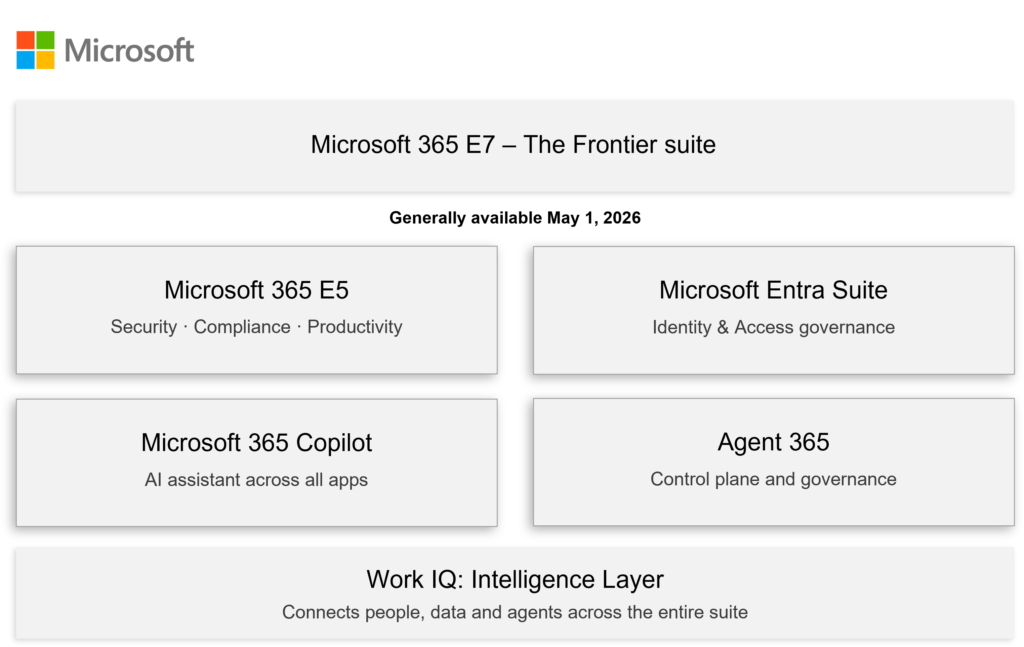
Microsoft 365 E7 brings together Microsoft 365 E5, Microsoft 365 Copilot, Entra Suite, and Agent 365, grounded in shared intelligence from Work IQ and built with trust to protect the organization.
- Microsoft 365 E5 is already the premium tier, covering advanced security, compliance, analytics, and the full productivity suite. Most large enterprises are on E3, with a minority having migrated to E5.
- Microsoft 365 Copilot is the AI assistant layer embedded across Word, Excel, Outlook, Teams, and more, now in its third wave, with expanded model diversity including both OpenAI and Anthropic models.
- Microsoft Entra Suite extends identity and access management capabilities beyond what E5 includes, covering external identities, private network access, and identity governance.
- Agent 365 is the governance control plane for AI agents across the organization, regardless of who built them. Whether your agents are created with Microsoft platforms, open-source frameworks, or third-party platforms, Agent 365 helps you deploy, organize, and govern them securely.
Agent 365: The Piece That Changes the Equation
The inclusion of Agent 365 in E7 is the strategic core of the announcement.
As Directions on Microsoft’s Director of Advisory Services Lane Shelton put it: “This isn’t about a new licensing tier. It’s about Microsoft positioning itself as the enterprise AI control plane for the emerging digital worker.“
The timing is deliberate. Organizations that have moved beyond AI pilots are encountering a new and familiar problem: no centralized view of the agents they’ve deployed, no clear picture of what data those agents can access, and no reliable way to demonstrate ROI to leadership. Agent 365 delivers unified observability across your entire agent fleet through telemetry, dashboards, and alerts, giving IT leaders the ability to track every agent being used, built, or brought into the organization, eliminating blind spots and reducing risk.
What makes this significant for business leaders is the scope. Whether built natively with Copilot Studio or Foundry, or sourced from partners like ServiceNow, Adobe, SAP, and Databricks, or even open-source agents built on LangChain, OpenAI, or Anthropic frameworks, Agent 365 is designed to bring all of them under a single governance layer.
Two concrete capabilities are worth calling out for business leaders. First, the Agent Store, a discovery layer built directly into Microsoft 365 Copilot and Teams, where employees can find and activate the right agents for their role and workflows. Think of it as an internal app store for AI agents: curated, governed, and accessible without IT tickets or custom deployments.
Second, IT-defined guardrails allow IT teams to define exactly who can create, onboard, and manage agents, with standard policy templates that apply from day one. This is the answer to the question data leaders will ask when AI agents start touching sensitive business data.
The Broader Strategic Bet
E7 sits inside a larger narrative Microsoft is building around what it calls the “Frontier Firm”, a human-led, agent-operated enterprise, turning human intent into AI action that functions securely and at scale.
Copilot is central to that vision. Rather than maintaining separate AI interfaces across departments and tools, Microsoft is pushing toward a model where Copilot becomes the unified surface for human-agent collaboration and where Work IQ, the intelligence layer that helps Copilot understand you, your job, and your company, provides the context that makes agents actually useful rather than generically capable.
Microsoft has also shifted to a flexible model approach, allowing customers to pick any model to power their AI assistants and agents. The implication: Microsoft is positioning itself as an orchestration platform, not a model monopolist. The best model for the task, whether from OpenAI, Anthropic, or elsewhere, runs within the Copilot interface, under the governance of Agent 365, on top of the data layer your organization already controls.
The Question Worth Asking Before May 1
The E7 framing is coherent and well-packaged. But the value of Agent 365, and of agentic AI broadly, depends on what sits beneath it.
Agents governed by Agent 365 still need access to data that is clean, well-structured, and properly permissioned. The governance layer is only as strong as the data foundation it operates on. For many organizations, that foundation, not the licensing decision, is where the real work lies.
E7 goes generally available May 1. The organizations that will extract the most from it are the ones that use the coming weeks to assess not just whether to adopt, but whether their data and operational infrastructure is ready to support agents working at enterprise scale.
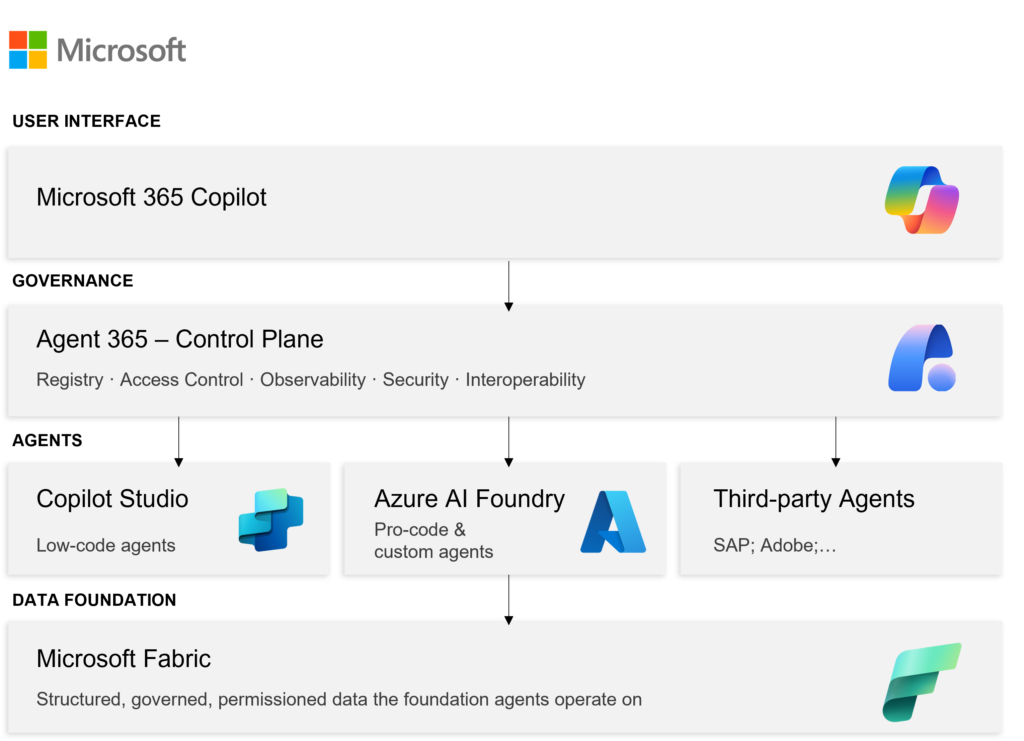
E7 goes generally available May 1. The licensing decision is straightforward. What’s harder, and what most organizations underestimate, is whether their data infrastructure, governance model, and internal readiness are actually prepared to support agents working at enterprise scale. That gap between buying the suite and extracting value from it is exactly where the work happens.
Ready to move to enterprise AI?
Our experts run a focused workshop to help you assess your readiness for E7 and Agent 365, covering your data foundations, agent governance strategy, and the concrete steps to get there.